

Building a Student Pipeline on a Measured Micro Budget

CASE STUDY

Pipeline Value

Across nine and a half months, the program reached the same family audience nearly one million times at an average cost per click of AUD $1.08.
0
Enrolment Applications
0
Campus Tours
0
Lead Form Submissions
0
Scholarship Engagements
$
0
Total Ad Spend
$
0
Campaign Spend
$
0
Approx. Lead Value
This Is LD was engaged to plan, build, and manage a 10-month paid social program on Facebook and Instagram, with the dual mandate of generating qualified enrolment leads and building sustained awareness among Australian families considering private school education for their children.

We worked with an independent ELC–Year 12 school operating across multiple campuses in South Australia.

The campaign ran across four distinct phases, each with a different conversion objective.

Paid social spend across all phases came in at approximately AUD $17,666, making this a deliberately efficient, performance-focused program rather than a high-volume media buy.

Program at a Glance

Across the full program, LD managed seven campaigns, produced 60+ ad variants through systematic copy and creative testing, and tracked outcomes across multiple conversion types including tour bookings, lead form submissions, application starts, prospectus downloads, and scholarship enquiries.
0
Total Impressions
0
Total Clicks
$
0
Total Spend (AUD)

Our Challenge

Independent schools operate in a long-cycle decision environment. Families researching a school for their child often do so 12–24 months ahead of an enrolment decision. Paid social needs to work simultaneously at two levels: reaching families at the top of the funnel who are first becoming aware of a school, and converting those already in consideration who need a clear next step.

The college also operates across multiple campuses, each drawing from different catchment areas and catering to different age groups from Early Learning through to Year 12. That layered audience profile required distinct targeting, messaging, and landing page experiences for each segment, rather than a single broad campaign.

The brief to LD was clear: build a pipeline of qualified enquiries, keep cost-per-result accountable, and use social to extend the school’s brand presence among families who may not yet be actively searching.

Our Process
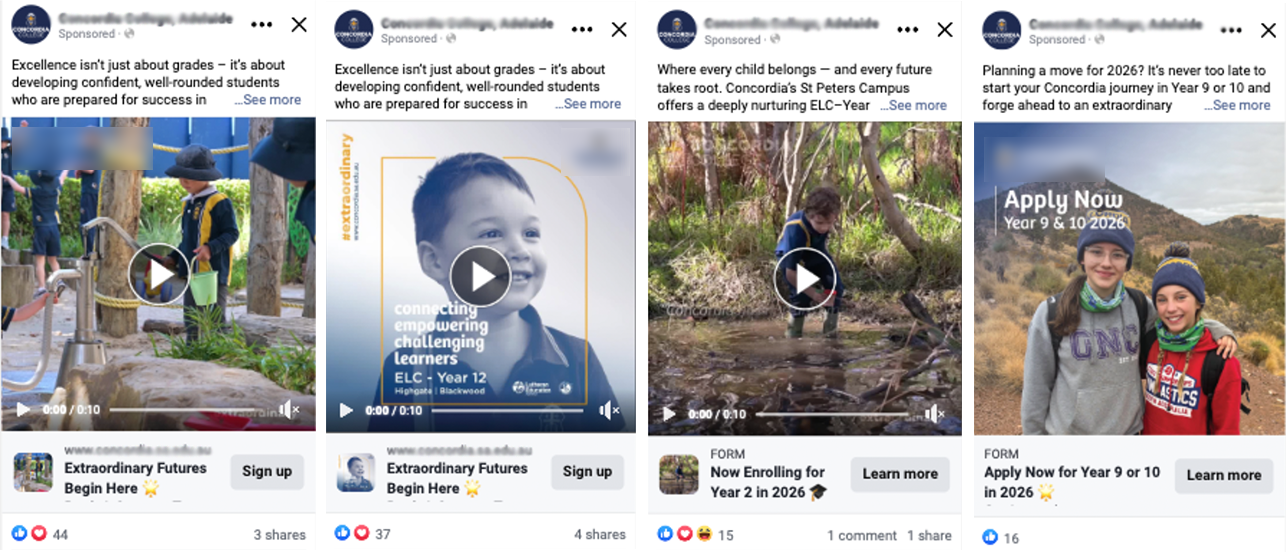
LD structured the year into four sequential campaign phases, each designed around a different point in the enrolment funnel.

Phase 1: Landing Page Campaigns & Enrolment Awareness

The program opened with two segmented landing page campaigns. One targeting families with children in ELC to Year 6, and a second for Years 7–12. Two dedicated landing pages were built on the website, each customised by age group with specific messaging, imagery, and conversion actions. Ad creative was developed through rigorous variant testing: five core copy frameworks were tested against both landing pages, across multiple audience targets, video formats, and static imagery. This produced more than 60 individual ads, with data from early performance informing which combinations to scale. The primary conversion action was booking a campus tour, tracked as a ‘Website Schedule’. Secondary conversion actions included prospectus downloads, application starts, and direct contact via phone or email.

Phase 2: Lead Form Campaigns & Campus-Specific Targeting

The mid-year phase shifted format, moving from landing page traffic to native Facebook lead forms. Three campaigns ran simultaneously, each focused on a specific campus or year group: Campus A, Campus B, and a Year 9/10 lateral entry audience. Families considering a school move partway through secondary school. Lead forms were chosen here for their frictionless completion on mobile, reducing the drop-off that can occur when users are taken away from the app. The lower barrier to entry also suited an audience that may be in earlier-stage consideration rather than ready to book a tour.

Phase 3: Tour Booking Campaign

A short, high-intensity campaign ran in the lead-up to the end of the academic year, targeting families already in market to book a campus tour before 2026 enrolment decisions closed. A dedicated all-campuses landing page was used, with urgency-led creative reflecting the time-limited open tour calendar.

Phase 4: Scholarships Campaign

The final phase targeted families exploring scholarship opportunities for 2027 entry, across Years 7–12. This was a content-led campaign driving traffic to the scholarships landing page, with results measured across page engagement, application clicks, and information requests — a broader definition of conversion appropriate for a higher-consideration product.

The Results by Phase

Phase 1: Landing Page Campaigns & Enrolment Awareness

Spend: AUD $6,555.94
408,000 impressions from a sub-$7K spend represents strong top-of-funnel reach for a regional independent school. The multi-conversion tracking approach is worth noting: LD measured intent at every level, from prospectus downloads (low commitment, high-interest) through to application starts (high intent). The 44 application starts from this phase alone represent a meaningful pipeline of families who moved from ad click to beginning the enrolment process.
Metric Result
Impressions
408,664
Clicks
8,242
Landing Page Views
1,656
Tour Bookings Started (Primary Result)
29
Application Starts
44
Prospectus Downloads
20
Direct Contact (Email / Phone)
6
Cost Per Tour Booking Started
AUD $226.07

Phase 2: Lead Form Campaigns

Spend: AUD $7,110.10
37 qualified leads at an average cost of AUD $192 per lead is a strong result in the education sector, where a single enrolled student typically generates annual tuition revenue in the range of AUD $15,000–25,000+. Campus A was the standout performer with both the highest lead volume and the lowest cost per lead of any campus campaign. The Year 9/10 lateral entry campaign, while generating fewer leads, identified a high-intent niche audience; families actively considering a mid-school move that warrants continued investment.
Metric Result
Impressions
324,037
Clicks
6,000
CTR
1.85%
CPC
AUD $1.19

Lead Form Submissions

37

Cost Per Lead

AUD $192.15

Campus A Leads
21 @ AUD $152.33 CPL
Campus B Leads
12 @ AUD $266.64 CPL
Year 9/10 Entry Leads
4 @ AUD $177.85 CPL

Phase 3: Tour Bookings Campaign

Spend: AUD $2,000.00
A focused two-week push with a AUD $2,000 budget delivered 12 tour bookings at a cost of AUD $166.67 each. For context, a campus tour is arguably the highest-value conversion in independent school marketing — it moves a family from passive interest into a direct, in-person relationship with the school. The campaign’s brevity and efficiency demonstrate that well-structured short bursts, with the right creative and a clear single call to action, can outperform longer, diffuse campaigns.
Metric Result
Impressions
98,190
Clicks
1,632
CTR
1.66%
CPC
AUD $1.23
Tour Bookings Submitted
12
Cost Per Booking
AUD $166.67

Phase 4: Scholarships Campaign

Spend: AUD $2,000.00
The scholarships campaign produced the lowest cost-per-result of any phase at AUD $12.90, driven by a broad content engagement objective rather than a single hard conversion. 155 meaningful interactions with the scholarships page, including application clicks, from a one-month, AUD $2,000 spend reflects both strong creative performance and genuine audience appetite for the scholarship offer. The CPC of AUD $0.95 was also the most efficient of the year.
Metric Result
Impressions
132,756
Clicks
2,116
CTR
1.59%
CPC
AUD $0.95
Scholarship Page Results (views, application clicks, info requests)
155
Cost Per Result
AUD $12.90

Full Program Summary

Across nine and a half months, the program reached the same family audience nearly one million times at an average cost per click of AUD $1.08. No phase operated in isolation: awareness built in Phase 1 supported the lead form efficiency seen in Phase 2; the tour urgency of Phase 3 captured families already warmed by months of exposure; and the scholarships campaign closed the year by re-engaging a motivated audience segment at minimal cost.
0
Enrolment Applications
0
Campus Tours
0
Lead Form Submissions
0
Scholarship Engagements
$
0
Total Ad Spend
$
0
Campaign Spend
$
0
Approx. Lead Value

What Worked

Audience segmentation by campus and age group.

Splitting campaigns by ELC–Year 6 and Year 7–12, and by campus, allowed LD to tailor creative and messaging to the specific concerns of each parent audience. Primary school parents and secondary school parents are not the same buyer, and the data confirmed that segment-specific campaigns consistently outperformed generic ones.

Systematic creative testing.

Five core copy frameworks, tested across multiple landing pages, audiences, and creative formats, produced over 60 ads. This volume wasn’t a spray-and-pray approach — it was a structured variable test that allowed clear identification of which copy direction, imagery, and CTA combination drove the best results for each objective. That learning was carried forward into each successive phase.

Multi-conversion tracking.

Rather than optimising to a single hard conversion, the Phase 1 LP campaigns tracked intent at every stage: downloads, contact initiations, application starts, and completed applications. This gave the school a much clearer picture of the real pipeline value generated by their ad spend, beyond what a single conversion metric would reveal.

Short, focused burst campaigns.

The tour bookings campaign spent AUD $2,000 over two weeks and produced 12 confirmed tour bookings. The scholarships campaign spent the same amount and generated 155 page-level engagement results at AUD $0.95 per click. Tight budgets with clear single objectives consistently performed above benchmark.

Video as primary creative format.

Short-form video (10–17 seconds) featured prominently among the best-performing ads across all phases. Campus life footage, student-centred imagery, and community-driven visual storytelling outperformed static formats in engagement and conversion rate.

What This Means for Other Schools

Paid social in education is often underutilised, or approached as a brand exercise without accountability. This program demonstrates that with proper structure, it can function as a genuine lead generation channel with measurable cost-per-enrolment-lead economics.
A few things are worth noting for any school considering a similar approach:
SCALE YOUR BUSINESS GLOBALLY

Back Yourself With An Healthcare Marketing Team

Get a customized growth plan tailored to your industry requirements and revenue goals.
WE DO IT ALL FOR YOU

AGENCY HIRE

A fully managed and executed digital marketing strategy and business growth service that is customised to your budget, target audience, industry and business goals.
GET STARTED
WE GUIDE YOUR DIY STRATEGY

CONSULTANT

An expert consultant to help guide your own efforts by providing marketing and audience analysis, business and industry insights, and solution-based strategies to execute.
GET STARTED
LET’S COLLABORATE

Working in a regulated or complex industry? Let's talk about what's possible.

Whether you’re building a global marketing programme from scratch, entering a new market, or rebuilding an underperforming digital presence, we’d like to understand what you’re working with and show you what we’d do differently.